

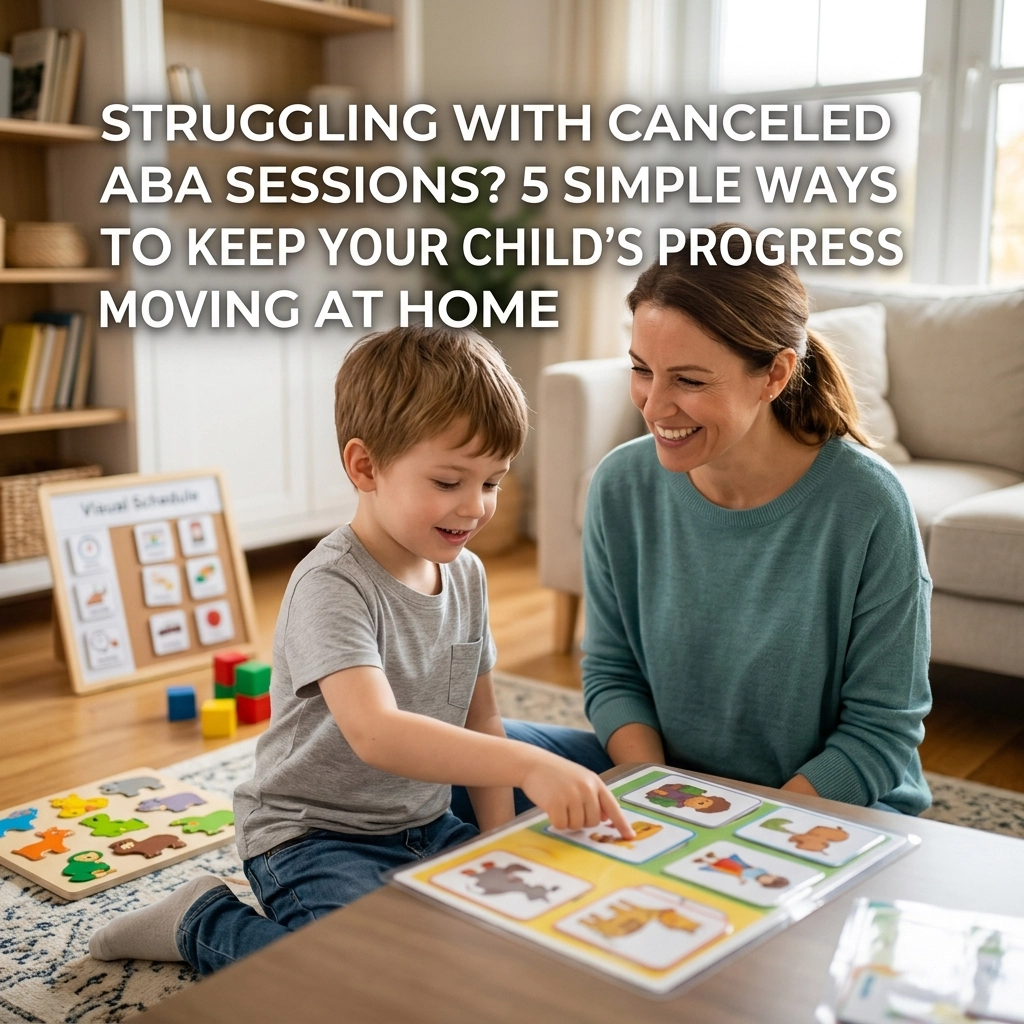
Struggling With Canceled ABA Sessions? 5 Simple Ways to Keep Your Child’s Progress Moving at Home
Canceled Applied Behavior Analysis (ABA) sessions are a reality for many families in Georgia. Whether due to seasonal illnesses, unpredictable Atlanta traffic, or staffing shortages, these gaps in service can cause significant anxiety for parents. Consistency is the primary driver of skill acquisition and behavior reduction. When the routine breaks, progress can stall.
At Myers Assessment & Therapeutic Service (MATS), we prioritize clinical continuity. We understand that therapy does not only happen within the walls of a clinic or during a scheduled home visit. It happens in the natural environment. Maintaining progress during cancellations requires a proactive, data-driven approach.
The Importance of Clinical Continuity in Georgia
Georgia families often navigate a complex landscape of special education services and private therapies. When a Board Certified Behavior Analyst (BCBA) or Registered Behavior Technician (RBT) cannot make a session, the responsibility of maintaining the Behavior Intervention Plan (BIP) often falls to the caregiver.
Regression is a common concern. Without regular reinforcement, newly acquired skills may weaken. However, by implementing specific evidence-based strategies, you can turn a canceled session into an opportunity for Natural Environment Teaching (NET).
1. Utilize Visual Schedules to Maintain Predictability
Predictability reduces problem behavior. Most ABA programs utilize visual schedules to help children transition between tasks. When a session is canceled, the child’s "normal" routine is disrupted. This disruption can lead to increased stress and "acting out."
Create a home-based visual schedule that mirrors the structure of a therapy session. Use pictures or written words to outline the day's events. Include specific times for "work" (structured tasks) and "earned breaks" (reinforcement).
How to Implement Visual Supports at Home:
- First/Then Boards: Use a simple "First [Task], Then [Reward]" visual. This clarifies expectations and utilizes Premack’s Principle.
- Timer Integration: Use visual timers to show how much time is left for a preferred activity. This assists with transitions.
- Activity Schedules: Break down complex tasks, like handwashing or getting dressed, into visual steps.

2. Implement Positive Reinforcement Systems
Reinforcement is the heart of ABA. During a canceled session, it is vital to keep the child’s motivation high. You must identify what currently motivates your child: this is known as a Preference Assessment.
A common mistake is providing "free access" to highly preferred items (like tablets or specific toys) throughout the day when a session is canceled. This reduces the child's motivation to work for those items later. Instead, keep those high-value items reserved for when the child follows a direction or completes a task.
Strategic Reinforcement Tips:
- Immediate Delivery: Provide the reinforcer immediately after the desired behavior occurs.
- Vary the Rewards: Use a mix of social praise, physical touch (high-fives), and tangible items.
- Token Economies: If your child uses a token board in therapy, continue using it at home. This maintains the "language" of therapy.
If you need more resources on behavioral supports, visit our services page to see how we structure our clinical programs.
3. Focus on Natural Environment Teaching (NET)
You do not need a clinical setting to teach. Natural Environment Teaching (NET) involves using the child's natural interests and daily routines to teach skills. This is often more effective for generalization: the ability to use a skill in different settings with different people.
When a session is canceled, look for "teachable moments" in your daily Georgia life. Whether you are at a park in Marietta or a grocery store in Alpharetta, opportunities for learning are everywhere.
Examples of NET at Home:
- Mealtime: Practice requesting (manding). Instead of giving the whole juice box, give a small sip and wait for the child to ask for "more" or "juice."
- Laundry: Practice sorting by color or item type. This builds categorization skills.
- Playtime: Work on turn-taking and social communication. Use a ball or a car to practice "my turn" and "your turn."

4. Use Behavioral Momentum to Increase Compliance
If your child is struggling with the change in routine, they may become more non-compliant. Behavioral Momentum (High-Probability Request Sequence) is a clinical technique used to increase the likelihood of a child following a difficult instruction.
To do this, give 2-3 "easy" instructions that the child is very likely to do (High-p). Follow those immediately with the "hard" or "target" instruction (Low-p).
The Sequence:
- "Give me a high-five!" (Easy)
- "Touch your nose!" (Easy)
- "Great job! Now, put your shoes in the closet." (Target/Hard)
This builds a "momentum" of success and reinforcement, making the child more likely to comply with the final, more difficult task.
5. Align with Georgia IEP and BIP Goals
Consistency across environments is critical for children enrolled in Georgia’s special education systems. If your child has an Individualized Education Program (IEP) or a formal Functional Behavior Assessment (FBA) on file, their ABA goals likely align with these documents.
Review the goals your BCBA has set. Are they working on "Functional Communication Training" (FCT)? Are they focusing on "Activities of Daily Living" (ADLs)? Focus your home efforts on these specific areas.
Stay Connected with Your Clinical Team:
- Request Data Sheets: Ask your RBT or BCBA for simple data sheets you can fill out during the gap in service.
- Review the BIP: Ensure you are responding to problem behaviors in the same way the therapists do. Consistency in "extinction" (not reinforcing the problem behavior) is essential.
- Communication Logs: Keep a record of what happened during the canceled session to share with the team when they return.

Technical Deep Dive: DTT vs. NET at Home
Parents often ask if they should try to do Discrete Trial Training (DTT) at home. DTT is highly structured and repetitive. While effective in a clinic, it can be difficult for parents to replicate without formal training.
We recommend parents focus on NET. It is more fluid and less stressful for the family dynamic. While an RBT might do 20 trials of "point to blue" at a table, a parent can do the same 20 trials while playing with blocks or looking at cars in the driveway. This leads to better generalization of the skill.
Tracking Progress: Why Data Matters
In the world of ABA, if it isn't written down, it didn't happen. You don't need a master's degree to track basic progress. Use a simple notebook or a note-taking app on your phone.
What to track:
- Frequency: How many times did a specific behavior occur?
- Duration: How long did a tantrum last?
- Antecedent: What happened right before the behavior?
- Consequence: What happened right after the behavior?
Sharing this "parent-collected data" with your BCBA at Myers Assessment & Therapeutic Service (MATS) allows them to adjust the treatment plan more accurately. It shows how the child functions when the clinical structure is removed.

How MATS Supports Georgia Families
At Myers Assessment & Therapeutic Service (MATS), we are committed to more than just scheduled hours. We provide comprehensive support that includes caregiver training and community-based resources. We understand the unique challenges faced by families seeking allied healthcare and disability assistance in Georgia.
If you are experiencing frequent cancellations or feel your current home program is not meeting your child’s needs, it may be time to review your service plan. We offer specialized services ranging from community nursing to physical activities tailored for those with developmental needs.
Conclusion
Canceled ABA sessions are a hurdle, but they do not have to be a roadblock. By maintaining a schedule, using high-value reinforcement, and focusing on natural learning opportunities, you ensure that your child continues to gain independence.
You are your child's first and most important teacher. While the clinicians provide the roadmap, your consistency at home provides the fuel for long-term success.
For more information on our therapeutic approaches and how we can support your family's journey, explore our full list of services or contact us today.