
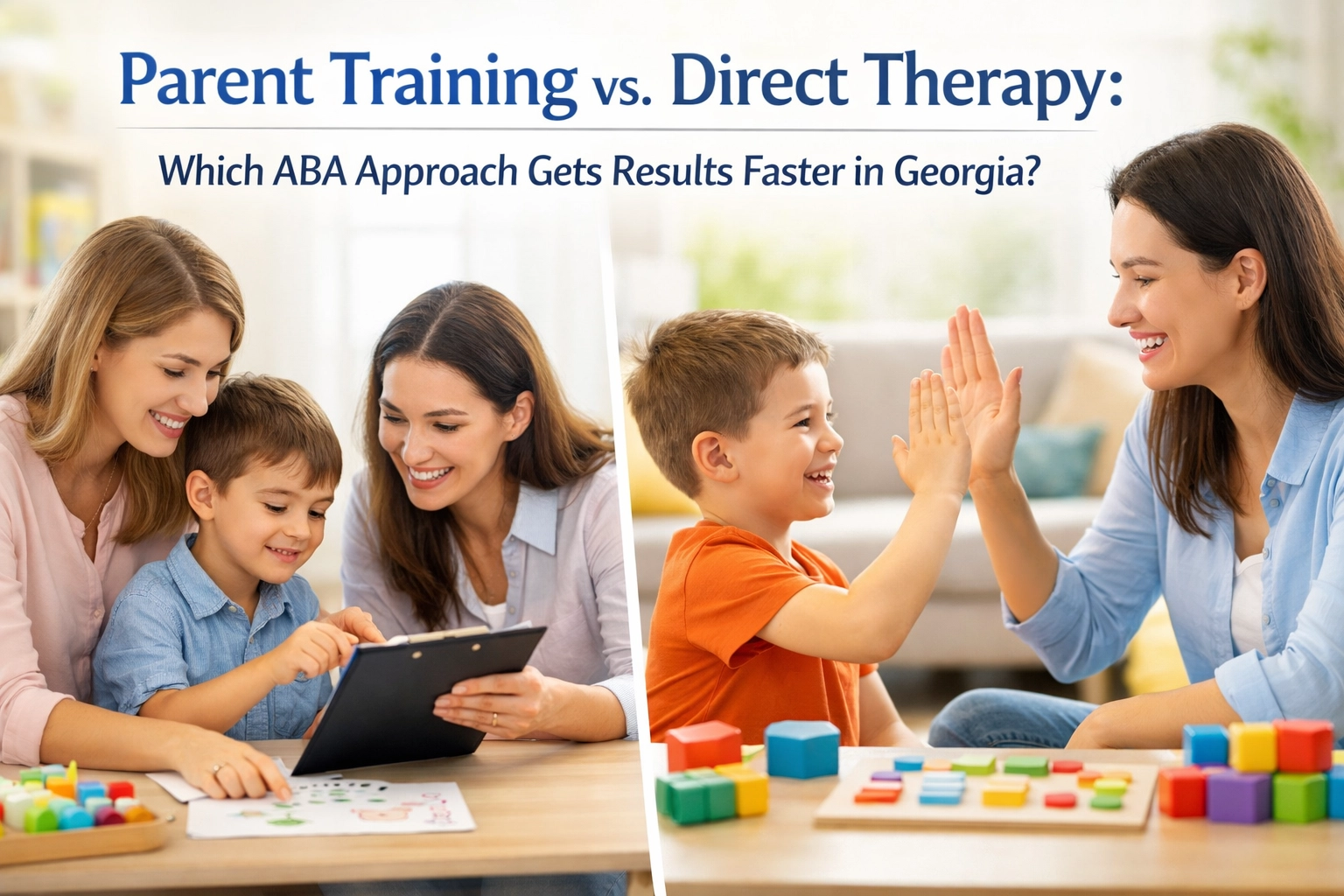
Parent Training vs. Direct Therapy: Which ABA Approach Gets Results Faster in Georgia?
Parents across Fayette County, Tyrone, and Peachtree City ask us this question all the time: "Which gets results faster: having a therapist work directly with my child, or learning how to do it myself?"
It's a fair question. Time matters when you're navigating autism, developmental delays, or challenging behaviors. You want to see progress. You want your child to learn, grow, and gain independence.
Here's the honest answer: Direct therapy builds the foundation. Parent training makes those skills stick everywhere: and that's what leads to faster, lasting results.
At Myers Assessment & Therapeutic Service (MATS), we don't make families choose between the two. Our Support to Parents Training program integrates both approaches because the research is clear: combined intervention produces better outcomes than either method alone.
Let's break down what each approach does, why both matter, and how MATS helps Georgia families get the fastest, most effective results through ABA therapy.
What is Direct Therapy in ABA?
Direct therapy means a trained professional works one-on-one with your child.
This is what most people picture when they think of ABA therapy. A Board Certified Behavior Analyst (BCBA) or Registered Behavior Technician (RBT) sits with your child and runs structured teaching sessions designed to build specific skills.

Direct therapy targets measurable goals like:
- Communication skills (requesting, labeling, conversational turn-taking)
- Social skills (sharing, joint attention, peer interaction)
- Self-care routines (toileting, dressing, feeding)
- Academic readiness (following instructions, sitting for tasks, pre-literacy skills)
- Behavior reduction (decreasing aggression, self-injury, elopement, or tantrums)
The professional controls the environment. They deliver prompts. They reinforce correct responses. They collect data to measure progress.
Direct therapy is essential because it provides the intensive, systematic instruction children need to learn new skills. A trained clinician knows how to break down complex behaviors, fade prompts effectively, and troubleshoot when progress stalls.
But here's the limitation: If skills only happen during therapy sessions, they don't generalize.
A child who asks for snacks beautifully at the therapy table might still melt down in the kitchen at home. A child who sits perfectly during structured work might refuse to sit at the dinner table with family.
That's where parent training enters the equation.
What is Parent Training in ABA?
Parent training equips caregivers with the same tools the professionals use.
Instead of just watching therapy happen, parents learn how to implement ABA strategies in daily life. This includes understanding the principles of behavior, recognizing the function of challenging behaviors, and applying evidence-based interventions consistently.
Parent training isn't about turning you into a therapist. It's about empowering you to support your child's learning in the moments that matter most: at breakfast, during bath time, at the grocery store, on the playground.
Effective parent training involves:
- Live coaching during real-life situations
- Modeling of ABA techniques by the clinician
- Practice opportunities with immediate feedback
- Individualized strategies tailored to your family's routines and values
- Data collection training so you can track progress at home
Research shows that parent training produces a 47.7% decrease in challenging behaviors compared to 31.8% with parent education alone. That difference matters.
When parents actively participate in intervention, children make faster progress because learning isn't confined to a therapy room. It happens everywhere.
The Speed Question: Which Gets Results Faster?
Let's get specific about what "faster results" actually means.
Direct therapy delivers faster skill acquisition.
A trained clinician can teach a new skill efficiently because they control all the variables. They know exactly when to prompt, when to fade, when to reinforce. They run multiple learning trials in a single session.
If your child needs to learn to request a drink using a picture card, a skilled RBT can teach that skill quickly through structured discrete trial training (DTT).
But parent training delivers faster generalization.
Generalization means the skill works in the real world: not just at the therapy table.
A child who learns to request a drink during therapy might not use that skill at home, at school, or at Grandma's house unless parents know how to prompt and reinforce it in those settings.
That's the gap parent training fills.
When parents implement ABA strategies throughout the day, children practice skills in natural contexts. They learn that communication works everywhere. They build independence faster because they're applying skills in real-life situations with real-life consequences.
Here's the truth: Direct therapy without parent training produces slower long-term results. Parent training without professional guidance misses the technical precision needed for complex goals.
The fastest results come from both working together.
Why Parent Training Actually Accelerates Progress
Parent involvement isn't just a nice bonus. It's a clinical game-changer.

Consistency Across Environments
Children with autism often struggle with generalization. A skill learned in one setting doesn't automatically transfer to another.
When parents use the same strategies the therapist uses, the child experiences consistent intervention across home, community, and therapy settings. That consistency speeds up learning.
Increased Learning Opportunities
A child receiving 10 hours of direct therapy per week gets 10 hours of structured learning.
A child whose parents implement ABA strategies throughout daily routines gets dozens of additional learning opportunities every single day: during meals, transitions, play, and bedtime.
More practice equals faster skill development.
Immediate Intervention for Challenging Behaviors
Challenging behaviors don't wait for therapy sessions. Meltdowns happen at 6 a.m. Aggression happens at the grocery store. Elopement happens at the park.
When parents know how to respond effectively in the moment: using differential reinforcement, antecedent modifications, and functional communication training: they prevent behaviors from escalating and reinforce appropriate alternatives immediately.
Real-World Skill Building
Academic skills at a table are one thing. Functional independence in daily life is another.
Parent training ensures that skills translate into real-world competence. A child learns to request help not just during therapy, but when they actually need help getting dressed, opening a container, or finding a toy.
The MATS Approach: Support to Parents Training
At MATS, we don't just offer parent training as an add-on. It's embedded in everything we do.
Our Support to Parents Training program provides:
Individualized Coaching
Every family receives personalized training based on their child's goals, their daily routines, and their specific challenges. We don't use cookie-cutter approaches.
In-Home and Community-Based Training
We train parents in the environments where they need support most: at home, during outings, and in community settings across Fayette County and surrounding areas.
Hands-On Practice with Feedback
Parents don't just watch videos or read handouts. They practice interventions with their child while our BCBAs provide real-time coaching and feedback.
Ongoing Support
Parent training isn't a one-time workshop. It's an ongoing process. As your child's skills grow and new challenges emerge, we adjust our training to meet your evolving needs.
Collaboration with Direct Therapy
Our RBTs and BCBAs coordinate closely to ensure parents are reinforcing the same skills being taught during direct therapy sessions. This alignment maximizes progress.
Naturalistic Teaching (NET) in Daily Life
MATS uses a naturalistic teaching approach that makes parent training easier and more effective.

Instead of drilling flashcards at a table, Natural Environment Teaching (NET) embeds learning into play and daily routines.
Your child learns to request during snack time. They practice turn-taking during playtime with siblings. They work on following directions while getting dressed.
NET is ideal for parent implementation because it:
- Uses activities your child already enjoys (high motivation)
- Happens in the places where you spend time together (natural context)
- Feels less like "therapy" and more like everyday life (reduced resistance)
- Builds skills that immediately improve daily functioning (practical outcomes)
When we train parents in NET strategies, they learn to turn ordinary moments into learning opportunities. No special materials required. No rigid structure. Just intentional, strategic interaction woven into the fabric of daily life.
This approach is particularly effective for Georgia families managing busy schedules across Tyrone, Peachtree City, and Fayette County. You don't need to carve out extra therapy time. You work on goals during the time you already spend with your child.
Direct Therapy + Parent Training = Fastest Results
The question isn't really "which is faster?" The question is "how do we combine both for maximum impact?"
Here's what the research-backed model looks like:
Phase 1: Foundation Building (Direct Therapy Focus)
Early intervention begins with intensive direct therapy. A BCBA conducts a Functional Behavior Assessment (FBA) and develops an individualized treatment plan. RBTs implement structured teaching to build foundational skills.
During this phase, parents observe sessions and begin learning basic ABA principles.
Phase 2: Skill Transfer (Integrated Approach)
As the child acquires new skills in therapy, parent training intensifies. Parents learn to prompt, reinforce, and generalize those same skills at home and in the community.
Direct therapy continues, but parents become active co-interventionists.
Phase 3: Generalization and Maintenance (Parent Training Focus)
Once core skills are established, direct therapy hours may decrease while parent training support increases. The focus shifts to ensuring skills work everywhere, with everyone, across all contexts.
Parents become confident, competent implementers who can maintain progress independently.
This model produces the fastest results because it leverages professional expertise for skill acquisition and parental consistency for generalization.
Children don't just learn skills. They use them independently in the real world. And that's the outcome every family in Georgia is working toward.
Ready to See Faster Results for Your Child?
If you're in Fayette County, Tyrone, Peachtree City, or surrounding Georgia areas, MATS offers comprehensive ABA therapy that integrates direct therapy and parent training for maximum effectiveness.
We don't make you choose between professional intervention and parental involvement. We give you both.
Our Support to Parents Training program equips you with the skills, confidence, and ongoing support you need to help your child succeed: not just during therapy sessions, but in every moment of every day.
Contact MATS today to schedule a consultation. Let's build a treatment plan that delivers the fastest, most meaningful results for your child and your family.
Because when parents and professionals work together, children thrive.