
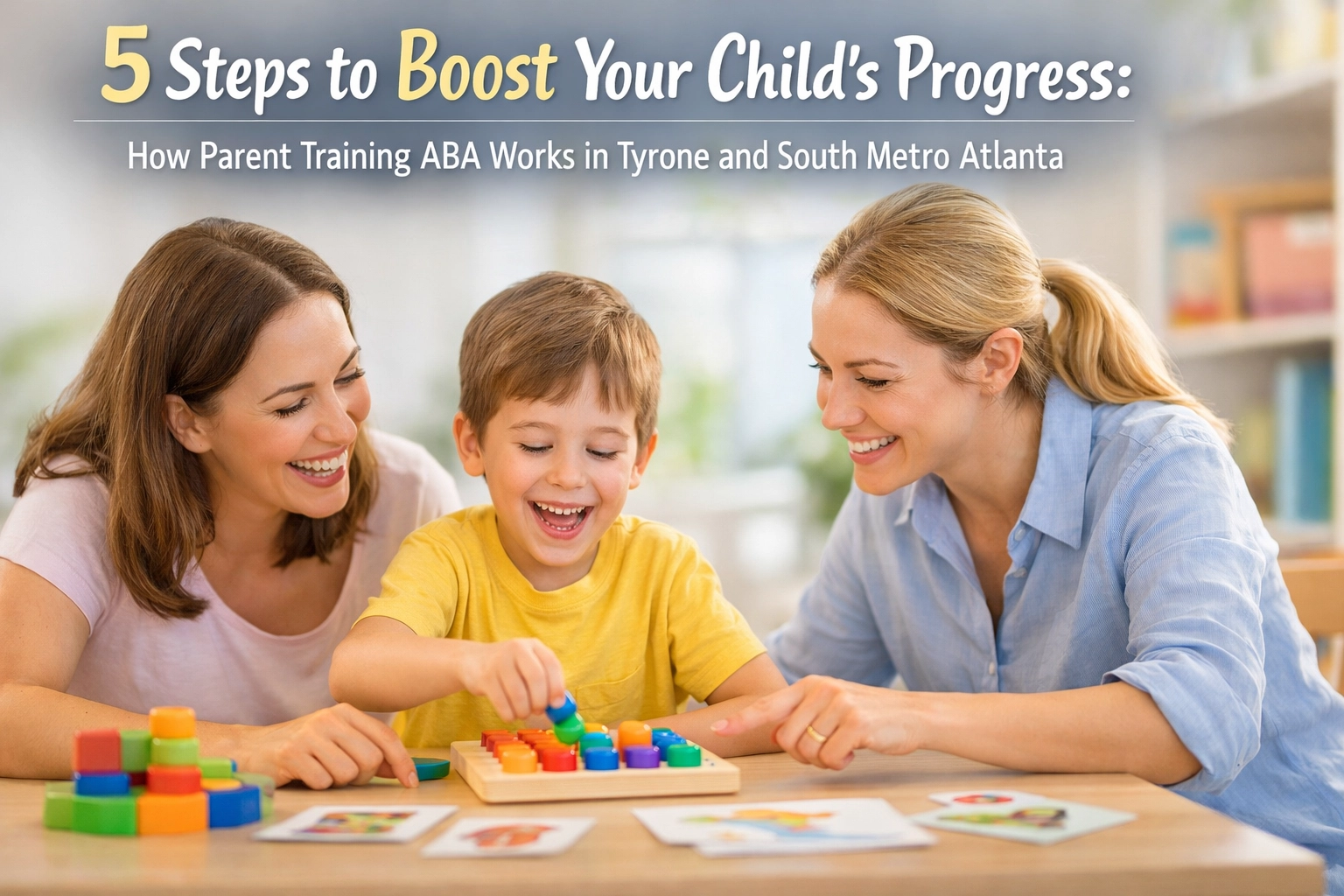
5 Steps to Boost Your Child’s Progress: How Parent Training ABA Works in Tyrone and South Metro Atlanta
Your child makes incredible progress during therapy sessions. But when you get home, challenging behaviors return. The skills they mastered at the clinic disappear by dinnertime.
This disconnect frustrates Georgia families every day.
Parent training ABA bridges this gap. When caregivers learn evidence-based strategies, children generalize skills across all environments. Progress accelerates. Stress decreases. Families regain confidence.
At MATS, we've worked with hundreds of families throughout Tyrone, Fayetteville, Peachtree City, and South Metro Atlanta. Our parent training component isn't optional: it's essential to every treatment plan.
Here's exactly how it works.
Step 1: Establish Consistency Between Clinic and Home
The most common barrier to progress? Environmental inconsistency.
Children with autism often struggle with generalization. A skill learned in one setting doesn't automatically transfer to another. When therapy techniques differ between clinic and home, confusion results.
Parent training eliminates this barrier.
Your child's BCBA uses specific prompting hierarchies, reinforcement schedules, and response protocols. Parent training sessions teach you these exact methods. You learn the same language, the same cues, the same consequences.

What this looks like at MATS:
- BCBAs demonstrate techniques during your child's therapy sessions
- You observe implementation in real-time
- Therapists explain the rationale behind each strategy
- You practice under direct supervision
- Feedback is immediate and specific
The result? Your child experiences consistent expectations across environments. Tantrums decrease. Cooperation increases. Skills maintain and generalize.
Step 2: Learn What Happens in a Parent Training Session
Many Georgia families hesitate to engage in parent training. They worry it will feel like criticism or judgment.
Effective parent training is collaborative, not evaluative.
At MATS, typical parent training sessions follow a structured format:
Review and Assessment (10-15 minutes)
Your BCBA reviews recent data and progress. You discuss challenges from the previous week. Goals are adjusted based on current performance.
Skill Demonstration (15-20 minutes)
The BCBA models a specific technique with your child. This might include:
- Implementing a token economy system
- Using errorless teaching for a new skill
- Managing escape-maintained behavior
- Prompting appropriate communication
Parent Practice (20-25 minutes)
You implement the technique while your BCBA observes. Real-time coaching occurs. The BCBA provides specific feedback on timing, delivery, and response.
Planning and Homework (10 minutes)
You identify opportunities to practice throughout the week. Data collection methods are established. Questions are addressed.

Sessions occur regularly: typically weekly or biweekly depending on your treatment plan and insurance authorization. Many Georgia Medicaid plans and commercial insurers cover parent training as a billable service.
Step 3: Master Positive Reinforcement Strategies
The foundation of ABA is positive reinforcement. When a behavior is followed by a desirable consequence, that behavior increases in frequency.
Sounds simple. Implementation requires precision.
Common mistakes Georgia parents make:
- Providing reinforcement too late (timing matters: deliver within 1-2 seconds)
- Using the same reinforcer repeatedly until it loses effectiveness
- Accidentally reinforcing problem behaviors
- Failing to pair social praise with tangible rewards
- Providing reinforcement on a continuous schedule without fading
Parent training teaches you to:
Identify High-Value Reinforcers
Your child's BCBA conducts preference assessments. You learn which items, activities, and interactions motivate your child most effectively.
Use Strategic Timing
Reinforcement must immediately follow the desired behavior. Delayed reinforcement weakens the connection. Parent training includes practice with real-time scenarios to build your timing accuracy.
Implement Token Economy Systems
Many children respond well to token boards or point systems. You learn how to establish the system, determine token-to-backup reinforcer ratios, and fade the system as skills strengthen.
Fade Reinforcement Schedules
Initially, every instance of a behavior receives reinforcement (continuous schedule). As the behavior strengthens, reinforcement becomes intermittent. This maintains the behavior while reducing dependence on external rewards.

Practical Example for South Metro Atlanta Families:
Your child struggles with transitions between activities. During parent training, you learn to:
- Provide a 5-minute warning before transitions
- Use a visual timer your child can monitor
- Deliver immediate, specific praise when they transition cooperatively ("Great job putting your toys away when the timer beeped!")
- Provide access to a preferred activity as reinforcement
- Collect data on successful transitions to monitor progress
Within weeks, transitions improve. Your stress decreases. Your child experiences more success throughout the day.
Step 4: Implement Effective Prompting Techniques
Prompts are cues that help your child perform a skill correctly. Proper prompting prevents errors and builds confidence. Improper prompting creates dependency.
Parent training teaches you prompt hierarchies: starting with maximum support and systematically fading to independence.
Common Prompting Methods:
Physical Prompts
Hand-over-hand guidance. Used sparingly and faded quickly to prevent dependence.
Gestural Prompts
Pointing, nodding, or other non-verbal cues that direct attention or action.
Verbal Prompts
Direct instructions, indirect questions, or verbal cues. These range from full verbal prompts ("Put the cup on the table") to partial prompts ("Put the…").
Visual Prompts
Pictures, written words, or visual schedules that guide behavior.
The key principle: Always use the least intrusive prompt necessary. Start with minimal support. Increase only if needed. Fade systematically.
Your BCBA trains you to:
- Select appropriate prompts for specific skills
- Deliver prompts with precise timing (simultaneous or delayed)
- Recognize when to fade prompt levels
- Avoid prompt dependency
- Collect data on prompt levels to measure progress toward independence
Many Tyrone and Fayetteville families see dramatic progress when prompting becomes consistent across environments. Skills emerge faster. Independence develops more completely.
Step 5: Reduce Caregiver Stress Through Data-Informed Strategies
Raising a child with autism creates significant stress. Uncertainty amplifies it.
When do I intervene?
Is this strategy working?
Am I making things worse?
Parent training provides objective answers through data collection.

Simple Data Collection Methods You'll Learn:
Frequency Data
Count how many times a behavior occurs. Track tantrums, requests, appropriate greetings, or any discrete behavior.
Duration Data
Measure how long a behavior lasts. Useful for tantrums, task engagement, or sustained attention.
ABC Data
Record the Antecedent (what happened before), the Behavior itself, and the Consequence (what happened after). This reveals patterns and informs function-based interventions.
Your BCBA provides:
- Simple data sheets designed for busy parents
- Training on when and how to collect data
- Regular review of your data to identify trends
- Adjustments to strategies based on objective results
The impact on stress is significant.
Instead of feeling helpless during challenging moments, you have clear protocols. Instead of wondering if strategies work, you see measurable progress. Instead of second-guessing your responses, you follow evidence-based procedures.
Georgia families consistently report that data collection reduces anxiety. Uncertainty decreases. Confidence increases.
Parent Training Strengthens the Entire Treatment Plan
At MATS, parent training isn't supplemental: it's foundational.
When you implement ABA strategies consistently at home, your child's progress accelerates across all domains:
- Communication skills generalize to family meals and community settings
- Social skills strengthen during playdates and family gatherings
- Daily living skills develop naturally within home routines
- Problem behaviors decrease as you respond effectively and consistently
Your involvement transforms therapy outcomes.
Next Steps for Tyrone and South Metro Atlanta Families
If your child currently receives ABA services, ask about parent training components. If parent training isn't part of your treatment plan, request it. Most insurance plans: including Georgia Medicaid: cover these sessions.
If you're exploring ABA services, prioritize providers who emphasize parent training. Interview potential BCBAs about their approach to caregiver involvement.

At MATS, parent training is integrated into every treatment plan. Our BCBAs serve families throughout Fayetteville, Tyrone, Peachtree City, Newnan, and surrounding South Metro Atlanta communities.
We offer flexible scheduling to accommodate working parents. Sessions occur at our clinic or in your home depending on goals and insurance coverage.
Contact us to learn how parent training can accelerate your child's progress and reduce your family's stress.
Your involvement makes the difference between progress during therapy sessions and transformation across your child's entire life.