
30-40 Hours of ABA Therapy Per Week: What Does That Actually Look Like for Your Family?
When your child's BCBA recommends 30-40 hours of ABA therapy per week, it's normal to feel overwhelmed. That sounds like a full-time job: because it is. But here's the thing: those hours aren't just about keeping your child busy. They're about creating enough opportunities for learning, practicing, and mastering the skills they need to thrive.
If you're a Georgia family navigating Early Intensive Behavioral Intervention (EIBI), you probably have questions. What does 30-40 hours actually look like day-to-day? Will your child still have time to be a kid? How do you balance therapy with naps, meals, and family time?
Let's break it down.
Why Intensity Matters for Early Intervention
The recommendation for 30-40 hours isn't arbitrary. Research consistently shows that intensive early intervention leads to the most significant developmental gains: especially for young children under three years old diagnosed with autism.
Here's why intensity works:
Repetition builds skills. Young children with autism often need more opportunities to practice skills than their neurotypical peers. More hours mean more chances to learn, generalize, and master new behaviors.
Early intervention closes developmental gaps. The goal of EIBI in Georgia isn't just to teach isolated skills. It's to help your child catch up to developmental milestones and reduce the gap between where they are and where same-age peers are.
Consistency matters. Spreading therapy across multiple days and settings helps your child apply what they learn in the clinic to real-world situations: at home, in the grocery store, at the park.
Studies show that children receiving 30-40 hours of ABA therapy demonstrate greater gains in communication, social interaction, and adaptive skills compared to those receiving fewer hours. It's not about quantity for the sake of it. It's about giving your child the best chance to reach their potential.

What Does a 30-40 Hour Week Actually Look Like?
Let's talk logistics. A typical 30-40 hour ABA therapy schedule might include:
- 4-5 clinic sessions per week (mornings, 3-4 hours each)
- 2-3 home-based sessions per week (afternoons, 2-3 hours each)
- Parent training sessions built into the schedule
Sessions generally last 2-5 hours and are scheduled multiple times per week to reach the total hours. But here's the important part: those hours aren't all structured table work.
A Sample Weekly Schedule for a Georgia Family
Monday:
- 9:00 AM – 12:00 PM: Clinic session (structured teaching, small group play)
- Lunch and nap at home
- 3:00 PM – 5:00 PM: Home session (practicing skills in natural settings)
Tuesday:
- 9:00 AM – 12:30 PM: Clinic session
- Afternoon: Family time, playground visit
Wednesday:
- 9:00 AM – 12:00 PM: Clinic session
- 2:00 PM – 4:00 PM: Home session with parent training
Thursday:
- 9:00 AM – 12:30 PM: Clinic session
- Afternoon: Errands, community outings
Friday:
- 9:00 AM – 12:00 PM: Clinic session
- 3:00 PM – 5:00 PM: Home session
This sample schedule totals about 35 hours. Notice how it's balanced throughout the week and leaves room for naps, meals, and family activities.
Clinic-Based vs. Home-Based Hours: The MATS Approach
Not all therapy hours look the same. At MATS, we use a combination of clinic and home-based sessions to give your child a well-rounded experience.
Clinic-Based Sessions
Clinic sessions provide a structured environment where your child can:
- Learn foundational skills through Discrete Trial Training (DTT)
- Practice communication and social skills in small groups
- Work with therapists in a distraction-free setting
- Access specialized equipment and materials
Clinic sessions are ideal for teaching new skills and building mastery in a controlled environment.

Home-Based Sessions (Natural Environment Teaching)
Home sessions use Natural Environment Teaching (NET) to help your child apply what they've learned in the clinic to real-life situations. During home sessions, therapists work on:
- Playing with siblings and family members
- Following routines (mealtime, bedtime, getting dressed)
- Practicing communication during everyday activities
- Generalizing skills to your home environment
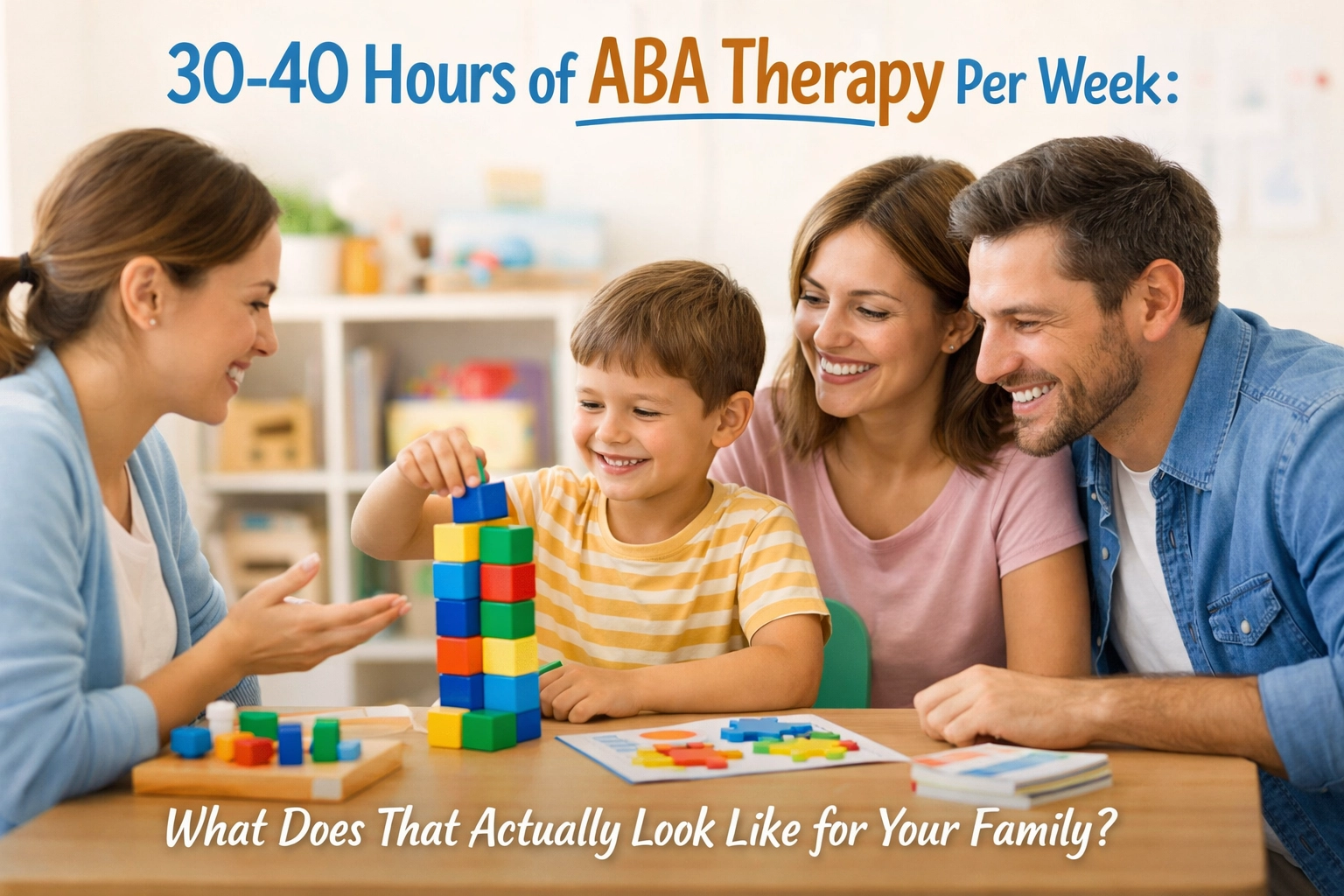
At MATS, we focus heavily on naturalistic ABA, which means therapy often looks like play. Your child might work on turn-taking while building with blocks, practice requesting while making a snack, or learn social skills during a game in the backyard.
This approach makes therapy feel less clinical and more integrated into your family's daily life.
Parent Training: You're Part of the Team
Here's something many Georgia families don't realize: those 30-40 hours include parent training and coaching.
Your involvement isn't optional: it's essential. The most successful ABA therapy outcomes happen when parents learn to use the same strategies therapists use.
During parent training sessions, you'll learn how to:
- Prompt and reinforce behaviors throughout the day
- Reduce challenging behaviors using evidence-based strategies
- Create opportunities for learning during daily routines
- Collect data to track your child's progress
Parent training is built into the schedule at MATS. You're not just watching from the sidelines. You're learning, practicing, and becoming your child's most effective teacher.

Managing the Schedule Without Burning Out
Let's be honest: 30-40 hours is a lot. It requires commitment, organization, and support. Here are practical tips to help your family manage:
1. Build a Visual Calendar
Use a large wall calendar or digital app to map out therapy sessions, appointments, and family time. Color-code clinic days vs. home days. This helps everyone in the household stay on the same page.
2. Protect Downtime
Your child needs time to rest, play freely, and just be a kid. Build nap time, quiet time, and unstructured play into the schedule. Don't overpack every minute.
3. Communicate with Your BCBA
If the schedule isn't working, speak up. ABA therapy hours can be adjusted based on your child's progress, your family's capacity, and other factors like preschool or additional therapies.
4. Lean on Your Support System
Ask family members, friends, or respite care providers to help with meals, errands, or sibling care. You can't pour from an empty cup.
5. Celebrate Small Wins
Intensive therapy can feel like a marathon. Celebrate progress: no matter how small. Your child is working hard. So are you.
Who Benefits from 30-40 Hours of ABA?
Intensive EIBI is typically recommended for:
- Young children under 3 years old diagnosed with autism
- Children with significant developmental delays across multiple areas
- Families whose goal is to close developmental gaps with neurotypical peers
Not every child needs 30-40 hours. Some children do well with 10-15 hours per week. Others need focused intervention for a short period and then transition to fewer hours.
The key is working with a qualified BCBA who assesses your child's needs and builds a plan tailored to your family.
Ready to Build a Schedule That Works?
At MATS, we know that recommending 30-40 hours of therapy can feel overwhelming for Georgia families. That's why we take a collaborative approach to building schedules that support your child's development without overwhelming your family.
We offer:
- Clinic and home-based ABA services in Fayette County and surrounding areas
- Natural Environment Teaching (NET) that makes therapy feel like play
- Parent training and coaching to help you support your child at home
- Flexible scheduling that considers your family's needs
30-40 hours of early intervention ABA in Georgia isn't just about the time: it's about the quality, the approach, and the partnership between therapists and families.
Contact MATS today to talk about building an EIBI schedule that works for your child and your family. Let's create a plan that feels manageable, effective, and focused on what matters most: helping your child thrive.